Welcome to the official website of MNI: Kill Wildlife Trafficking. Wander around our pages to find out what we're about, or enjoy updates and opinion columns on our home page. Let us know if you have any questions; remember, if you choose to make a difference, you can.
Showing posts with label endangered. Show all posts

Saturday, 14 September 2013

The Epulu Tragedy

The okapi is one of those enigmatic animals. You just can't quite figure them out. They're quiet and elusive, they live in the remote rain forests of central Africa, and they...have zebra stripes on their butts. Kind of.
An odd creature: the okapi's closest relative is actually the giraffe.  Photo courtesy of the Okapi Conservation Project.
I only recently had the chance to read about this story, and what happened is truly horrific. People died for these creatures, and they (the okapis) were killed anyways. It's a real spotlight on the brutality of humanity. It was all done in the name of vengeance.

The Epulu Station, situated deep in the forests of the Democratic Republic of Congo, had received threats from groups due to their work against poaching in the area. Agencies responsible for the conservation center (which housed nine okapis and numerous scientists) ignored the threats, and early one morning of June 2012, the station and the nearby village was pillaged and ransacked.

Two people and all the okapis on-site were murdered.

I just have one blaring question: why did the media never cover this?

This is also a stark reminder of how dangerous it is to be a conservationist these days. When people go out to save the environment, they really are risking their lives. They are everyday heroes: conservation work isn't just for the conservationist because their work benefits all of us.

I personally read this story only a few days after learning of the death of Jairo Mora Sandoval. I got chills.

Read what happened at the station in detail here.

Saturday, 7 September 2013

International Vulture Awareness Day

People don't like vultures. I get it. Even in the Lion King, vultures were portrayed as creepy and cackling.

A contemporary art print with a ring to it. From NathanJoyce.
But vultures, key players in numerous ecosystems, have been hit hard by a number of factors, and numbers everywhere have experienced steep declines. One of Save Our Species vulture conservation projects has listed population drops between 97-99% since 1990 for some species.

Much like owls (who have only seen a popularity revival due to the Harry Potter movies), vultures are seen as evil in many cultures, signs of bad omens. This translates into modern day life, where people everywhere turn their noses up at an animal that has the capacity to kill bacteria like E. coli by eating it.

Vultures are nature's cleaner-uppers. Without them, many infectious diseases would be far more widespread.

In Asia (yes, there are vultures here!), most vultures are killed while doing their jobs. Cattle today are often injected with a substance called Diclofenac, which proves fatal to these majestic birds when they appear to dispense of cattle carrion.

The beautiful bearded vulture, or lammergeier, from the Ethiopian highlands; a personal favorite. Image courtesy Martina Carrete.
International Vulture Awareness Day is now in its second year. If you want to get involved, they even have wikispaces page open to the public, but the main thing is to get the word out there: vultures are awesome!

Saturday, 10 August 2013

Another One Bites the Dust


"It is a sad fact that to many people the loss of a plant species is of less moment than the loss of a football match." 

Richard Fortey, Dry Store Room No. 1


This is "old news", considering this report is from about a week ago, but it still resonates with me.


Another species of Dipterocarpus. Picture from arkive.org
To be honest, it's amazing it was even reported. So many species slip by unnoticed into the realm of extinction while we are too preoccupied with the latest Facebook post. The keruing paya (Dipterocarpus coriaceus) is just one of hundreds that probably disappeared that day, most still unknown to modern science.

Losing a species is more of a tragedy than most people realize. Even if it is not one at the top of the food chain, it's loss still has a lasting impact on all the other species connected to it. In South America, these survival-oriented symbiotic relationships are to such an extent that if a single species of hummingbird were to go extinct, an entire specie of Heliconia would go with it.


A purple-throated carib, a specie of hummingbird that has evolved to eat almost entirely from a single species of Heliconia (hence the extensively curved beak). Picture by Ethan Temeles via Smithsonian Magazine Online.
Some say that losing a species is part of progress; but development is not the same as progress. We cannot continue to develop so irresponsibly if we want to have something other than a concrete jungle left.

The keruing paya, only one of a staggering 230 species of flora on the brink of extinction in peninsular Malaysia, is a stark reminder that we need to act now if we do not want to lose even more of our own biodiversity.


Wednesday, 7 August 2013

Happy World Lemur Month

I know, I know, lemurs seem to be a far cry from having any relevance to either Malaysia or wildlife trafficking. In fact, a vast array of tortoise seizures in our country originate in Madagascar. But I'm not going to get into that today. 

It is officially World Lemur Month! Arbitrary holiday though it may be (and there are no days off), it helps draw attention (as most of these World Anything Days/Months/Years tend to do) to a serious issue.


A Sifaka lemur bounds through the forest. Zaboomafoo, the American children's TV show character, was a Sifaka. Image by Burrard-Lucas/Barcroft via the Telegraph.
Our cute lemur friends are the most endangered group of vertebrates in the world. Of anything on this planet with a spine, these guys are at the highest risk of extinction, with a staggering 91% of species considered threatened by the IUCN, or the International Union for the Conservation of Nature.

 Lemurs, you could say, have drawn the short straw - they exist only one island, an island that has seen continuous political turmoil, economic exploitation, poverty, and naturally, deforestation. Less than a third of the island's original forests remain.

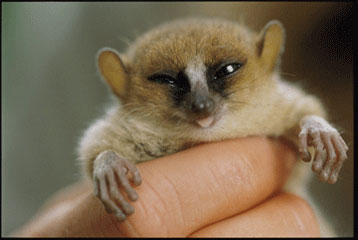
Even today, we do not know all that Madagascar holds. Just recently, three new species of lemur have been discovered, including this adorable little fellow below, whose common name has not yet been ascribed.
Microcebus mittermeieri, a newly discovered species of mouse lemur. It is small enough to fit into your hand. Photo from Mongabay.
Madagascar is a reminder that we do not, by any means, know all that our rain forests hold.

Saturday, 27 April 2013

World Tapir Day

This is a super fun holiday!

The tapir is one of the world's most interesting mammals - they look like no one and nothing else. Their closest relatives are, in fact, horses and rhinos.

There are four species of tapir in the world: the Brazilian, Baird's, Mountain, and Malayan. Only on of these is not under threat, and here's a hint: it's not the Malayan.

The Malayan tapir is possible the most distinct of the four species, with its quickly noticeable black-and-white markings. It is also the largest of the three species.

With a wild population numbering less than one thousand, the Malayan tapir is indeed endangered. However, this species is not threatened due to the wildlife trade (eating tapir is taboo in many of the cultures inhabiting the Southeast Asian region). Many are killed due to loss of habitat, and strangely enough, while crossing the road.

On a lighter note, here's a picture from Malaysian Nature Society; they had a special guest
at Taman Negara last night!


Saturday, 16 February 2013

World Pangolin Day

Happy World Pangolin Day!!

Yes, that is indeed a holiday.

If you say the word "pangolin," the chances are that people will give you a strange look and ask if meant "penguin." The same person will stare at you unbelieving eyes as you try to explain just what this creature is.

Don't let that person be you! Pangolins are amazing creatures that deserve recognition. So for World Pangolin Day, take the chance to learn some fun fact about them:

1. There are eight species of pangolin that range across the globe, from Africa to the Indian sub-continent. Malaysia has its own species, (creatively named) the Malayan pangolin.

2. All but two species are listed on Appendix II of CITES; the other two are on Appendix I. One of those is the Malayan pangolin. Malaysia has been considered one of the number one country of origin for pangolins for several years now.

3. The word "pangolin" actually comes from the Bahasa word for "to roll up," the word "penggiling."

Sunday, 10 February 2013

Fourteen Borneo Elephants Dead - Now What?

By now, wildlife enthusiasts everywhere have heard about the travesty that has become the recent Borneo pygmy elephant case.

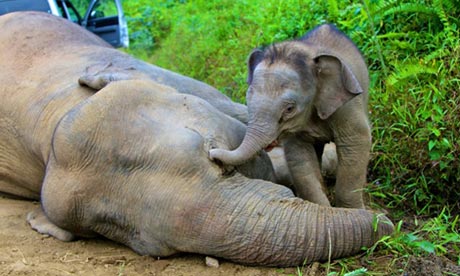
The death toll, surpassing fourteen individuals, is a devastating blow to the already fragile population of Bornean elephants. The most heart-wrenching portion of the story is attributed to the young calf, cowering over his dead mother's carcass, that has since been rescued by national officials. The calf, christened "Joe," now resides at the Lok Kawi Wildlife Park, but is not left unscarred by the passing of his mother and of his family.

Bornean pygmy elephants were only recently distinguished as a sub-species separate from their mainland cousins. With a population teetering around 1000, living in only small areas of the Malaysian state of Sabah, they are a CITES Appendix I Endangered Species.

Preliminary investigations point to poisoning by illegal loggers. All the animals were found with ruptured digestive organs.

While we are not anti-development, seeing development as a necessary step to improve a country, we do condone the activities of illegal loggers in protected areas. These elephants were killed on their own turf, by people who were not meant to be in the vicinity.

We hope those responsible will receive the proper sentencing.

Baby Joe tries to awaken his dead mother.
Image property of Reuters via The Guardian.