Welcome to the official website of MNI: Kill Wildlife Trafficking. Wander around our pages to find out what we're about, or enjoy updates and opinion columns on our home page. Let us know if you have any questions; remember, if you choose to make a difference, you can.
Showing posts with label species. Show all posts

Saturday, 21 September 2013

Fluff: the Sarcastic Fringehead

After last week's heavy topic, I thought I'd just give a shout out to one of the oddest fish in the sea: the sarcastic fringehead. Yes, that's an actual thing.

This image seems to sum up the supposed personality of the fish. Comic from Satisfactory Comics.
One almost feels like the scientist who named this fish was having troubles with a very sarcastic, fringe-headed teenager at home. Even better? These fish protect themselves with their big mouths.

These mouth-wrestling matches look something like this:


For more on the sarcastic fringehead,  you can look here, here, and here.

Saturday, 10 August 2013

Another One Bites the Dust


"It is a sad fact that to many people the loss of a plant species is of less moment than the loss of a football match." 

Richard Fortey, Dry Store Room No. 1


This is "old news", considering this report is from about a week ago, but it still resonates with me.


Another species of Dipterocarpus. Picture from arkive.org
To be honest, it's amazing it was even reported. So many species slip by unnoticed into the realm of extinction while we are too preoccupied with the latest Facebook post. The keruing paya (Dipterocarpus coriaceus) is just one of hundreds that probably disappeared that day, most still unknown to modern science.

Losing a species is more of a tragedy than most people realize. Even if it is not one at the top of the food chain, it's loss still has a lasting impact on all the other species connected to it. In South America, these survival-oriented symbiotic relationships are to such an extent that if a single species of hummingbird were to go extinct, an entire specie of Heliconia would go with it.


A purple-throated carib, a specie of hummingbird that has evolved to eat almost entirely from a single species of Heliconia (hence the extensively curved beak). Picture by Ethan Temeles via Smithsonian Magazine Online.
Some say that losing a species is part of progress; but development is not the same as progress. We cannot continue to develop so irresponsibly if we want to have something other than a concrete jungle left.

The keruing paya, only one of a staggering 230 species of flora on the brink of extinction in peninsular Malaysia, is a stark reminder that we need to act now if we do not want to lose even more of our own biodiversity.


Saturday, 27 April 2013

World Tapir Day

This is a super fun holiday!

The tapir is one of the world's most interesting mammals - they look like no one and nothing else. Their closest relatives are, in fact, horses and rhinos.

There are four species of tapir in the world: the Brazilian, Baird's, Mountain, and Malayan. Only on of these is not under threat, and here's a hint: it's not the Malayan.

The Malayan tapir is possible the most distinct of the four species, with its quickly noticeable black-and-white markings. It is also the largest of the three species.

With a wild population numbering less than one thousand, the Malayan tapir is indeed endangered. However, this species is not threatened due to the wildlife trade (eating tapir is taboo in many of the cultures inhabiting the Southeast Asian region). Many are killed due to loss of habitat, and strangely enough, while crossing the road.

On a lighter note, here's a picture from Malaysian Nature Society; they had a special guest
at Taman Negara last night!


Tuesday, 19 March 2013

CITES Conference A Success

Convention on International Trade in Endangered Species of Wild Fauna and Flora (CITES) recently finished a convention this year, 2013. Some of the topics they covered ranged from Rhino-poaching and Timber species. Let's take a look at some of the things they've agreed on:

  • Manta rays proposal. At a United Nations meeting on March 11, governments voted for better international trade controls on Manta Rays. Rays are highly sought after for their gill-plates which are very valuable, as well as for meat and skin. These things are traded internationally. Sadly, Manta Rays do not produce very quickly; one pup is born every 2-5 years. Because of these factors, poaching will soon threaten the Ray population  if not confronted. However, confronting is exactly what CITES did with the problem, and a proposal from Columbia and Ecuador listed Manta Rays under Appendix II of CITES. Now, more extreme measure will be taken to prevent the trafficking of this species.
  • Timber species. At this CITES convention many species of trees are now going to have better international shipping controls. Tropical species from Madagascar and Central America, as well as many more from around the world, were agreed upon as part of this decision.
  • Illegal toothfish fishing. This was not an issue that was spoken about, per se... more like a topic brought up and no one spoke. Many government officials were called out for breaking promises regarding these fish. While the issue of protection rights being violated is serious, it has not been resolved by the CITES council. Action being taken to reduce illegal toothfish fishing is minimal.
  • Tiger smuggling. Since 2010, a report has been being conducted about Tiger smuggling and poaching. Along with WWF, CITES launched a report called "Reduced to Skin and Bones Revisited" and results of these tiger seizure statistics are extremely shocking. They found that an average of 110 tigers were killed a year. From 2000-2012, 654 tiger part seizures were reported, these parts belonging to over 1,000 animals. CITES has decided to take more action, and some reinforcements to stop Tiger and big Asian cat trafficking in Asia and other parts of the world.
  • Other issues brought up were protection of different shark species, and ivory trade control. Decisions to limit shark fin and body part capture were accepted, causing great celebration among scientists and shark activists. Although there was some protest, these decisions were not recalled and there is more work being done to stop shark trade. Governments in Bangkok decided on more measures to restrict and control ivory trade, possibly due to the record-breaking statistics of elephant poaching in Africa.
This CITES convention covered many issues about animals and wildlife trafficking, and many measures were passed regarding the prevention and control of international wildlife trafficking. I think all of nature can certainly thank CITES for all their efforts in stopping wildlife trafficking in our world!

Saturday, 16 February 2013

World Pangolin Day

Happy World Pangolin Day!!

Yes, that is indeed a holiday.

If you say the word "pangolin," the chances are that people will give you a strange look and ask if meant "penguin." The same person will stare at you unbelieving eyes as you try to explain just what this creature is.

Don't let that person be you! Pangolins are amazing creatures that deserve recognition. So for World Pangolin Day, take the chance to learn some fun fact about them:

1. There are eight species of pangolin that range across the globe, from Africa to the Indian sub-continent. Malaysia has its own species, (creatively named) the Malayan pangolin.

2. All but two species are listed on Appendix II of CITES; the other two are on Appendix I. One of those is the Malayan pangolin. Malaysia has been considered one of the number one country of origin for pangolins for several years now.

3. The word "pangolin" actually comes from the Bahasa word for "to roll up," the word "penggiling."

Sunday, 10 February 2013

Fourteen Borneo Elephants Dead - Now What?

By now, wildlife enthusiasts everywhere have heard about the travesty that has become the recent Borneo pygmy elephant case.

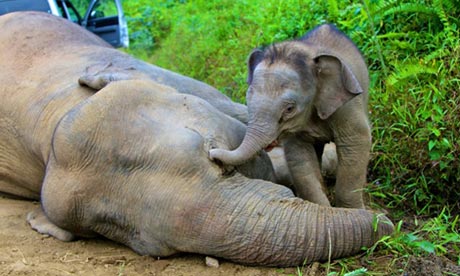
The death toll, surpassing fourteen individuals, is a devastating blow to the already fragile population of Bornean elephants. The most heart-wrenching portion of the story is attributed to the young calf, cowering over his dead mother's carcass, that has since been rescued by national officials. The calf, christened "Joe," now resides at the Lok Kawi Wildlife Park, but is not left unscarred by the passing of his mother and of his family.

Bornean pygmy elephants were only recently distinguished as a sub-species separate from their mainland cousins. With a population teetering around 1000, living in only small areas of the Malaysian state of Sabah, they are a CITES Appendix I Endangered Species.

Preliminary investigations point to poisoning by illegal loggers. All the animals were found with ruptured digestive organs.

While we are not anti-development, seeing development as a necessary step to improve a country, we do condone the activities of illegal loggers in protected areas. These elephants were killed on their own turf, by people who were not meant to be in the vicinity.

We hope those responsible will receive the proper sentencing.

Baby Joe tries to awaken his dead mother.
Image property of Reuters via The Guardian.