Welcome to the official website of MNI: Kill Wildlife Trafficking. Wander around our pages to find out what we're about, or enjoy updates and opinion columns on our home page. Let us know if you have any questions; remember, if you choose to make a difference, you can.
Showing posts with label rainforest. Show all posts

Wednesday, 7 August 2013

Happy World Lemur Month

I know, I know, lemurs seem to be a far cry from having any relevance to either Malaysia or wildlife trafficking. In fact, a vast array of tortoise seizures in our country originate in Madagascar. But I'm not going to get into that today. 

It is officially World Lemur Month! Arbitrary holiday though it may be (and there are no days off), it helps draw attention (as most of these World Anything Days/Months/Years tend to do) to a serious issue.


A Sifaka lemur bounds through the forest. Zaboomafoo, the American children's TV show character, was a Sifaka. Image by Burrard-Lucas/Barcroft via the Telegraph.
Our cute lemur friends are the most endangered group of vertebrates in the world. Of anything on this planet with a spine, these guys are at the highest risk of extinction, with a staggering 91% of species considered threatened by the IUCN, or the International Union for the Conservation of Nature.

 Lemurs, you could say, have drawn the short straw - they exist only one island, an island that has seen continuous political turmoil, economic exploitation, poverty, and naturally, deforestation. Less than a third of the island's original forests remain.

Even today, we do not know all that Madagascar holds. Just recently, three new species of lemur have been discovered, including this adorable little fellow below, whose common name has not yet been ascribed.
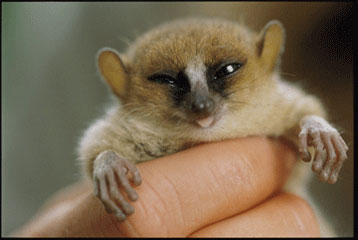
Microcebus mittermeieri, a newly discovered species of mouse lemur. It is small enough to fit into your hand. Photo from Mongabay.
Madagascar is a reminder that we do not, by any means, know all that our rain forests hold.

Saturday, 27 April 2013

World Tapir Day

This is a super fun holiday!

The tapir is one of the world's most interesting mammals - they look like no one and nothing else. Their closest relatives are, in fact, horses and rhinos.

There are four species of tapir in the world: the Brazilian, Baird's, Mountain, and Malayan. Only on of these is not under threat, and here's a hint: it's not the Malayan.

The Malayan tapir is possible the most distinct of the four species, with its quickly noticeable black-and-white markings. It is also the largest of the three species.

With a wild population numbering less than one thousand, the Malayan tapir is indeed endangered. However, this species is not threatened due to the wildlife trade (eating tapir is taboo in many of the cultures inhabiting the Southeast Asian region). Many are killed due to loss of habitat, and strangely enough, while crossing the road.

On a lighter note, here's a picture from Malaysian Nature Society; they had a special guest
at Taman Negara last night!


Saturday, 16 February 2013

World Pangolin Day

Happy World Pangolin Day!!

Yes, that is indeed a holiday.

If you say the word "pangolin," the chances are that people will give you a strange look and ask if meant "penguin." The same person will stare at you unbelieving eyes as you try to explain just what this creature is.

Don't let that person be you! Pangolins are amazing creatures that deserve recognition. So for World Pangolin Day, take the chance to learn some fun fact about them:

1. There are eight species of pangolin that range across the globe, from Africa to the Indian sub-continent. Malaysia has its own species, (creatively named) the Malayan pangolin.

2. All but two species are listed on Appendix II of CITES; the other two are on Appendix I. One of those is the Malayan pangolin. Malaysia has been considered one of the number one country of origin for pangolins for several years now.

3. The word "pangolin" actually comes from the Bahasa word for "to roll up," the word "penggiling."

Sunday, 10 February 2013

Fourteen Borneo Elephants Dead - Now What?

By now, wildlife enthusiasts everywhere have heard about the travesty that has become the recent Borneo pygmy elephant case.

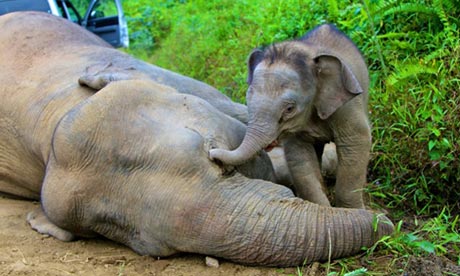
The death toll, surpassing fourteen individuals, is a devastating blow to the already fragile population of Bornean elephants. The most heart-wrenching portion of the story is attributed to the young calf, cowering over his dead mother's carcass, that has since been rescued by national officials. The calf, christened "Joe," now resides at the Lok Kawi Wildlife Park, but is not left unscarred by the passing of his mother and of his family.

Bornean pygmy elephants were only recently distinguished as a sub-species separate from their mainland cousins. With a population teetering around 1000, living in only small areas of the Malaysian state of Sabah, they are a CITES Appendix I Endangered Species.

Preliminary investigations point to poisoning by illegal loggers. All the animals were found with ruptured digestive organs.

While we are not anti-development, seeing development as a necessary step to improve a country, we do condone the activities of illegal loggers in protected areas. These elephants were killed on their own turf, by people who were not meant to be in the vicinity.

We hope those responsible will receive the proper sentencing.

Baby Joe tries to awaken his dead mother.
Image property of Reuters via The Guardian.