Welcome to the official website of MNI: Kill Wildlife Trafficking. Wander around our pages to find out what we're about, or enjoy updates and opinion columns on our home page. Let us know if you have any questions; remember, if you choose to make a difference, you can.
Showing posts with label elephant. Show all posts

Sunday, 7 July 2013

Breaking News!

http://www.reuters.com/article/2013/07/02/us-obama-wildlife-trafficking-idUSBRE96117Y20130702

This fantastic piece of news was released earlier this month. In new legislation, Obama hopes to curb trade in materials such as rhino horn and elephant tusk.

The United States is applauded for its commitment. Following statements regarding the wildlife trade earlier this year by former US Secretary of State Hillary Clinton, this pragmatic first step will be appreciated by wildlife everywhere. (Go here for more on what Clinton said at the time: http://www.state.gov/r/pa/prs/ps/2012/11/200355.htm) 

With connections between major terrorist groups and trafficking finally being acknowledged, it is a hope that support for the program will continue to grow.

While it focuses mainly on African issues with the trade, it is important to remember that most demand comes from the Pan-Asian region. Through educating this community about the "work" they are supporting, we all can play a role in curbing the illegal wildlife trade.

Tuesday, 19 March 2013

CITES Conference A Success

Convention on International Trade in Endangered Species of Wild Fauna and Flora (CITES) recently finished a convention this year, 2013. Some of the topics they covered ranged from Rhino-poaching and Timber species. Let's take a look at some of the things they've agreed on:

  • Manta rays proposal. At a United Nations meeting on March 11, governments voted for better international trade controls on Manta Rays. Rays are highly sought after for their gill-plates which are very valuable, as well as for meat and skin. These things are traded internationally. Sadly, Manta Rays do not produce very quickly; one pup is born every 2-5 years. Because of these factors, poaching will soon threaten the Ray population  if not confronted. However, confronting is exactly what CITES did with the problem, and a proposal from Columbia and Ecuador listed Manta Rays under Appendix II of CITES. Now, more extreme measure will be taken to prevent the trafficking of this species.
  • Timber species. At this CITES convention many species of trees are now going to have better international shipping controls. Tropical species from Madagascar and Central America, as well as many more from around the world, were agreed upon as part of this decision.
  • Illegal toothfish fishing. This was not an issue that was spoken about, per se... more like a topic brought up and no one spoke. Many government officials were called out for breaking promises regarding these fish. While the issue of protection rights being violated is serious, it has not been resolved by the CITES council. Action being taken to reduce illegal toothfish fishing is minimal.
  • Tiger smuggling. Since 2010, a report has been being conducted about Tiger smuggling and poaching. Along with WWF, CITES launched a report called "Reduced to Skin and Bones Revisited" and results of these tiger seizure statistics are extremely shocking. They found that an average of 110 tigers were killed a year. From 2000-2012, 654 tiger part seizures were reported, these parts belonging to over 1,000 animals. CITES has decided to take more action, and some reinforcements to stop Tiger and big Asian cat trafficking in Asia and other parts of the world.
  • Other issues brought up were protection of different shark species, and ivory trade control. Decisions to limit shark fin and body part capture were accepted, causing great celebration among scientists and shark activists. Although there was some protest, these decisions were not recalled and there is more work being done to stop shark trade. Governments in Bangkok decided on more measures to restrict and control ivory trade, possibly due to the record-breaking statistics of elephant poaching in Africa.
This CITES convention covered many issues about animals and wildlife trafficking, and many measures were passed regarding the prevention and control of international wildlife trafficking. I think all of nature can certainly thank CITES for all their efforts in stopping wildlife trafficking in our world!

Sunday, 10 February 2013

Fourteen Borneo Elephants Dead - Now What?

By now, wildlife enthusiasts everywhere have heard about the travesty that has become the recent Borneo pygmy elephant case.

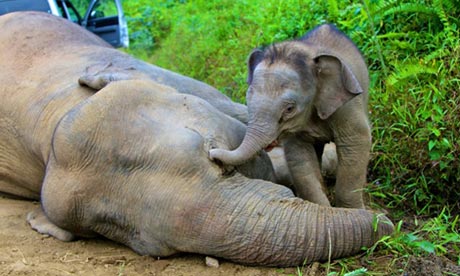
The death toll, surpassing fourteen individuals, is a devastating blow to the already fragile population of Bornean elephants. The most heart-wrenching portion of the story is attributed to the young calf, cowering over his dead mother's carcass, that has since been rescued by national officials. The calf, christened "Joe," now resides at the Lok Kawi Wildlife Park, but is not left unscarred by the passing of his mother and of his family.

Bornean pygmy elephants were only recently distinguished as a sub-species separate from their mainland cousins. With a population teetering around 1000, living in only small areas of the Malaysian state of Sabah, they are a CITES Appendix I Endangered Species.

Preliminary investigations point to poisoning by illegal loggers. All the animals were found with ruptured digestive organs.

While we are not anti-development, seeing development as a necessary step to improve a country, we do condone the activities of illegal loggers in protected areas. These elephants were killed on their own turf, by people who were not meant to be in the vicinity.

We hope those responsible will receive the proper sentencing.

Baby Joe tries to awaken his dead mother.
Image property of Reuters via The Guardian.