Welcome to the official website of MNI: Kill Wildlife Trafficking. Wander around our pages to find out what we're about, or enjoy updates and opinion columns on our home page. Let us know if you have any questions; remember, if you choose to make a difference, you can.
Showing posts with label conservation. Show all posts

Saturday, 14 September 2013

The Epulu Tragedy

The okapi is one of those enigmatic animals. You just can't quite figure them out. They're quiet and elusive, they live in the remote rain forests of central Africa, and they...have zebra stripes on their butts. Kind of.
An odd creature: the okapi's closest relative is actually the giraffe.  Photo courtesy of the Okapi Conservation Project.
I only recently had the chance to read about this story, and what happened is truly horrific. People died for these creatures, and they (the okapis) were killed anyways. It's a real spotlight on the brutality of humanity. It was all done in the name of vengeance.

The Epulu Station, situated deep in the forests of the Democratic Republic of Congo, had received threats from groups due to their work against poaching in the area. Agencies responsible for the conservation center (which housed nine okapis and numerous scientists) ignored the threats, and early one morning of June 2012, the station and the nearby village was pillaged and ransacked.

Two people and all the okapis on-site were murdered.

I just have one blaring question: why did the media never cover this?

This is also a stark reminder of how dangerous it is to be a conservationist these days. When people go out to save the environment, they really are risking their lives. They are everyday heroes: conservation work isn't just for the conservationist because their work benefits all of us.

I personally read this story only a few days after learning of the death of Jairo Mora Sandoval. I got chills.

Read what happened at the station in detail here.

Saturday, 7 September 2013

International Vulture Awareness Day

People don't like vultures. I get it. Even in the Lion King, vultures were portrayed as creepy and cackling.

A contemporary art print with a ring to it. From NathanJoyce.
But vultures, key players in numerous ecosystems, have been hit hard by a number of factors, and numbers everywhere have experienced steep declines. One of Save Our Species vulture conservation projects has listed population drops between 97-99% since 1990 for some species.

Much like owls (who have only seen a popularity revival due to the Harry Potter movies), vultures are seen as evil in many cultures, signs of bad omens. This translates into modern day life, where people everywhere turn their noses up at an animal that has the capacity to kill bacteria like E. coli by eating it.

Vultures are nature's cleaner-uppers. Without them, many infectious diseases would be far more widespread.

In Asia (yes, there are vultures here!), most vultures are killed while doing their jobs. Cattle today are often injected with a substance called Diclofenac, which proves fatal to these majestic birds when they appear to dispense of cattle carrion.

The beautiful bearded vulture, or lammergeier, from the Ethiopian highlands; a personal favorite. Image courtesy Martina Carrete.
International Vulture Awareness Day is now in its second year. If you want to get involved, they even have wikispaces page open to the public, but the main thing is to get the word out there: vultures are awesome!

Saturday, 17 August 2013

World Orangutan Day

Several weeks ago, an Italian member of parliament was called an orangutan by her colleagues. Although this was a racially-charged, insensitive and derogatory remark, I must say: I've met more than my fair share of cheeky, incredibly intelligent and totally adorable orangutans. I would take it as more of a compliment. 

Dozens of adorable babies like this one are orphaned every year and must then be rehabilitated in purpose-built centers like Sepilok, in Sabah, Borneo. Picture thanks to Orangutan Foundation International.
All this to say that two days from now we will be celebrating the inaugural World Orangutan Day!

Orangutans are one of the most iconic symbols of Southeast Asia. The "man of the forest" has been facing extinction for years, but recently, wild populations have plummeted despite repeated efforts from NGOs and government bodies alike.

This paragraph from the front of WOD's website gives startling statistics:
"From 1992-2000, the population of the Sumatran orangutan declined by more than 50% and only an estimated 7,000 animals are left in the wild. The Bornean orangutan population fell nearly 43 % in the past decade and estimates place their population at about 45,000 animals."

This lucky individual was found and sedated for transport and re-release into the wild, into a more viable habitat. Many orangs lose their lives in situations like this because plantations do not yet have adequate organization to deal with it. Image via EVOHE. 
As the Huffington Post outlines in this short editorial, however, orangutans are not safe yet. Bornean populations may sound promising, but they are not stable. Considering a constant influx of deforestation, less and less space is there for the orangutan. Pushed to the edge, many plantations have not yet learnt how to deal with the wild creatures wandering onto their land.

This World Orangutan Day, speak out.

Even BBC can get it wrong! In this Facebook screen capture, they spelled orangutan incorrectly!


Saturday, 6 July 2013

Irrational Fears Part 2

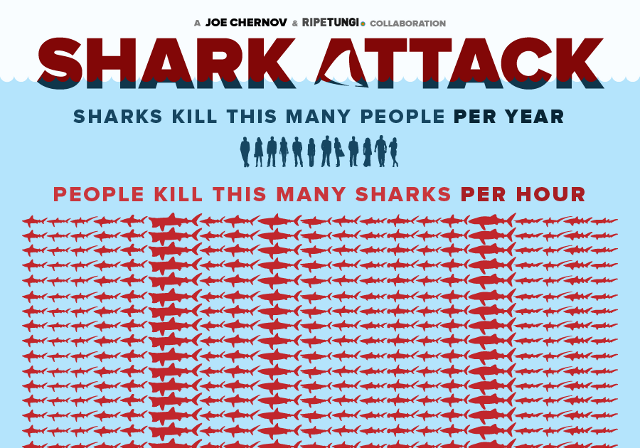
Somewhere in here, imagine a couple thousand more sharks. (Actually, between the two images you're only seeing about 600 sharks. Please do a lot of imagining.)
Twelve people is actually a high per year, as scary as that is. The total for all shark attacks in record numbers only a few hundred. You're more likely to die from alcohol than a shark attack. As the internet meme goes, though, "I too would attack anyone wandering into my house wearing only a speedo."

Revealing swimsuits aside, shark finning is a serious issue and a major player in the wildlife trade.

Essentially, finning is the practice where boats troll for sharks, and upon finding them, lift them out of the water and cut off only what is valuable - the fins. This is equivalent to having your arms and legs cut off - you're incapacitated at best. Once this is done, the shark is thrown back into the water (no one wants the rest of it, and why keep the evidence?) to drown. Since, you know, without arms or legs, it can't really swim anymore.

This fins are then thrown into giant freezers in hot spots around the world, such as Hong Kong, where they are then sent out to the world's top restaurants. Or they are dried and cured, to be sold at a market. Regardless, they all go for consumption.

The main culprit is the infamous Chinese dish, shark fin soup. Most restaurants now only serve a prosthetic plastic version, but some restaurants still carry the real deal. A true symbol of luck and prosperity, this is a dish many are unwilling to give up. As more of the world finds itself in a position to consume things it never could afford before, demand for traditional emblems such as shark fin soup rages and roars.

If we want to save the shark species of the world, we need to get over our fear of sharks and our ideas about shark fin soup. Eating shark can't be cool anymore; it can't remain a symbol of good.

Here are some stats to chew on in the meantime.

Friday, 5 July 2013

Irrational Fears Part 1

People are surrounded by irrational fears - spiders, for example.

What is the average house spider, barely the size of your pinky fingernail, going to do to you? Life is not a science-fiction movie. He will not turn into a giant monster and chase after you. In fact, he's great pest control; he's taking care of all the bugs you don't want in your house. You're unlikely to miss those, anyways.

While some fear is instinctual, some fear is taught. An issue I have been struggling for days, after witnessing the sudden death and mutilation of a snake at the hands of man.

I don't have a very good appetite for these sorts of things. It had begun before I could say anything, and before it was over, I had burst into tears.

To me, the act I had witnessed was barbaric. To the people around me, the act I had witnessed was normal, maybe even a fun sort of intermittent entertainment.
A large Indochinese Rat Snake. Photo credits to Ecology Asia.
The snake killed was a rat snake. A perfectly harmless animal in my eyes; it isn't even venomous. Less than two feet long, the young animal had unwittingly ventured into a truck of grain, probably hunting the rats it was named for.

But why are people so afraid?

Because they are taught to be. Now, everyone has self-preserving natural instincts, but these are easily overcome by most who want to. Some people are scared of heights, and they still climb. Some people are scared of speed, and they can still drive quickly. So why can't people get over their fear of snakes?

It's a cultural thing. If Hollywood hasn't created the image of menacing monster already, than Old Wives Tales have.

If we want to see people getting over their fear of snakes, we need to teach them about the ones they should be afraid of. People don't need to run away from rat snakes - they need to run away from cobras and kraits.

Next time I see a snake, I just want it to still be alive.

Thursday, 4 April 2013

A Sad Day in India

Today, WWF reported the death of a translocated Indian Greater One-Horned Rhinoceros in Manas National Park.

Shot by poachers, who took only her horn, the rhino left behind a 15-day-old calf, a declared conservation miracle at the time. There has been no report regarding the future of the calf.

This event highlights, yet again, the direct link between wildlife trade and the demise of world rhino populations.

This is not the first bad news of the year, however. South Africa reports almost 200 rhino killings in this year alone, a far cry of the total 13 lost only years ago. The Sumatran rhino has seen steep declines, now numbering less than 100 individuals in the wild. And for icing on a terrifying cake, the International Union for the Conservation of Nature (IUCN) has officially declared the Western Black Rhino extinct.

Rhino horn has no scientifically-proven medicinal value, but is considered "necessary" by the China Association of Traditional Chinese Medicine. (This is not to devalue traditional medicines, as some are truly effective; it is simply understood to be a major factor in the illegal wildlife trade.)

To learn more, be sure to drop by www.savingrhinos.org
Image courtesy of WWF Global.